Indian Harmonium
Why it Matters?
The Indian harmonium is unique for its non-electronic design and continued relevance in Indian classical, devotional, and folk music.
What You Should Know?
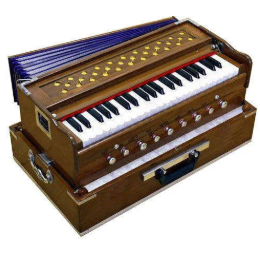
The Indian harmonium is a hand-pumped, reed-based musical instrument made of wood, metal, brass, and cloth.
It was originally developed in Europe (foot-pumped organ) and was adapted in India by Dwarkanath Ghose in 1875, who replaced foot bellows with hand-operated ones.
It is widely used in Indian classical, folk, devotional, Sufi, and ghazal music.
It is primarily used in Hindustani Classical Music.
Mechanism:
The player sits on the floor, pumping bellows with one hand and playing keys with the other.
Bellows draw in and push air into a pressurized wooden chamber beneath the keys.
When a key is pressed, it acts as a lever and lifts a felt-lined pallet, allowing air to flow toward a metal reed.
The reed vibrates due to airflow, producing sound.
Sound Production:
Reeds are made of brass or phosphor-bronze and fixed at one end.
Short and thin reeds produce high-pitched notes, while long and thick reeds produce low-pitched notes.
The player controls the loudness and expression by adjusting how strongly the bellows are pumped.
The harmonium has a natural, expressive sound because it responds directly to human hand movement and uses no electricity.
Special Features:
Stop rods near the keyboard allow the player to activate different reed banks, adding tonal variety.
A coupler lever lets a single key press also play the same note in another octave, enriching the sound.
Pitch can change with temperature and humidity, so musicians use manual tools to tune reeds before performances.
The harmonium can produce up to 12 surs (musical notes) and 22 shrutis (microtones).