Solar Corona
Why it Matters?
Indian astronomers from the Indian Institute of Astrophysics (IIA) discovered miniature plasma loops in the Sun’s chromosphere, offering new insights into magnetic energy release and heating, using data from Big Bear Solar Observatory (BBSO), Interface Region Imaging Spectrograph (IRIS), and NASA’s Solar Dynamics Observatory (SDO).
What You Should Know?
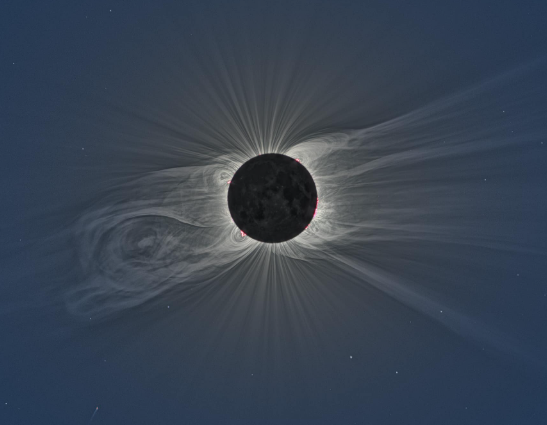
The Sun’s corona is the outermost layer of the Sun's atmosphere, visible only during a Total Solar Eclipse or using specialized instruments.
It is millions of degrees hot, yet appears dim because it is about 10 million times less dense than the Sun’s photosphere (visible surface).
Direct viewing of the Sun (except during totality) is unsafe without specialized eye protection, such as ISO-certified solar filters.
The corona is hundreds of times hotter than the Sun’s surface (~1 million Kelvin vs ~6,000 Kelvin), a mystery in solar physics.
The Interface Region Imaging Spectrograph (IRIS) mission by the National Aeronautics and Space Administration (NASA) discovered “heat bombs”—packets of hot plasma that may help heat the corona.
The Sun’s magnetic fields create dramatic corona features like coronal loops, plumes, and streamers, which trap hot plasma.
Coronal loops are arc-like structures of magnetically confined plasma, often reaching temperatures above 1 million Kelvin.
The corona is the origin of the solar wind—a stream of charged particles (plasma) that travel through space, affecting planetary magnetospheres.
Miniature Plasma Loops in the Sun’s Atmosphere:
Miniature plasma loops are newly discovered small structures in the Sun’s lower atmosphere (chromosphere).
They measure about 3,000 - 4,000 km in length and less than 100 km in width, and they live for only a few minutes.
These loops were discovered using multi-wavelength data from:
NASA's Solar Dynamics Observatory (SDO)
Interface Region Imaging Spectrograph (IRIS)
Goode Solar Telescope (BBSO, USA)
These loops were seen for the first time in the H-alpha spectral line (Hydrogen), a key diagnostic for the solar chromosphere.
The plasma inside these loops reaches temperatures of several million degrees, unusually high for chromospheric regions.
The heating mechanism is linked to magnetic reconnection, a key process in solar physics where magnetic fields realign and release energy.
The loops are linked with plasma jets and rapid energy bursts similar to solar flares and larger coronal loops.
These findings help explain how the Sun’s magnetic energy is stored and released on small spatial scales.
India’s proposed National Large Solar Telescope (NLST), to be set up near Pangong Lake in Ladakh, aims to study such features with greater resolution.