Gharial
Why it Matters?
The 21st Steering Committee meeting of Project Elephant reviewed elephant conservation efforts, including population estimation, railway collision mitigation, and inclusion of sloth bear and gharial in the Species Recovery Programme.
What You Should Know?
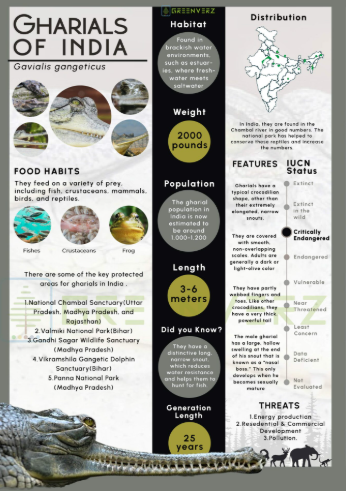
Gharials are freshwater crocodiles belonging to the Order Crocodylia and Family Crocodylidae.
Historically, gharials were found in rivers of India, Nepal, Pakistan, Bangladesh, Bhutan, and Myanmar.
Major present populations are confined to the Chambal and Girwa Rivers (India) and the Rapti-Naryani River (Nepal).
In India, gharial reserves are located in Uttar Pradesh, Madhya Pradesh, and Rajasthan.
Gharials are among the largest crocodilian species, with males reaching 16–20 feet and females 11.5–15 feet in length.
They have thick skin with smooth, non-overlapping scales, offering a distinct texture. The snout is the thinnest and most elongated among all crocodilians.
Adult males possess a prominent bulbous structure called ‘ghara’ on the snout, used during mating rituals.
Gharials are highly aquatic and rarely venture far from water bodies.
Mating occurs between November and January, and egg laying takes place between March and May.
Major threats include overhunting for skin, trophies, eggs, and their use in traditional medicine.
Additional threats are habitat destruction, pollution, and river development projects.
Conservation status:
IUCN Red List: Critically Endangered
CITES: Appendix I
Wildlife (Protection) Act, 1972: Schedule I