BrahMos Missile
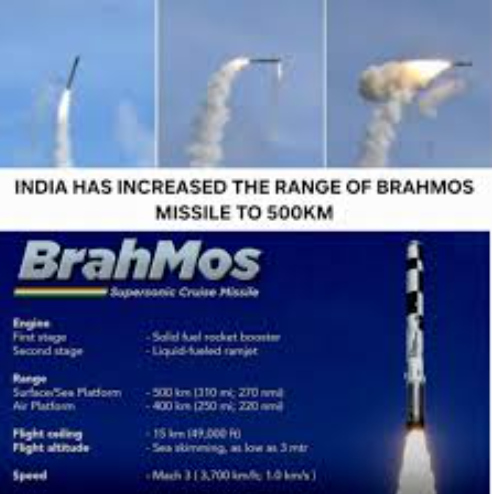
Context: The BrahMos manufacturing unit set to be unveiled in Lucknow will produce 80-100 missiles a year.
Important Pointers:
► BrahMos: Supersonic cruise missile developed by India’s DRDO and Russia’s NPO Mashinostroyeniya.
► Named after: Brahmaputra (India) and Moskva (Russia) rivers.
► Developed by: BrahMos Aerospace, established in 1998 via an India-Russia agreement.
► Technical Specifications:
Two-stage missile: Solid propellant booster (first stage) for supersonic speed; liquid ramjet (second stage) for Mach 2.8–3.0.
Range: Initially 290 km (MTCR-limited); post-2016 MTCR membership, extended to 450–600 km, with recent versions up to 800 km.
Weight: 2,200–3,000 kg; 200–300 kg conventional warhead (nuclear-capable).
Speed and Altitude: Cruises at Mach 2.8–3.0, altitude up to 15 km, terminal altitude as low as 10 meters.
► Features:
“Fire and Forget” principle: No guidance needed post-launch.
Stealth technology: Low radar signature for evasion.
Navigation: INS for ships, INS/GPS for land targets.
Multi-platform: Launchable from land, air, sea, and submarines (e.g., Su-30MKI, naval ships, mobile launchers).
► Variants and Upgrades:
Operational variants: Land-launched (2007, Army), ship-launched (2005, Navy), air-launched (2019, Su-30MKI).
Extended-range: Tested May 2022 from Su-30MKI, range 350–500 km.
BrahMos-NG: Lighter (1.6 tonnes), smaller (6 meters), Mach 3.5, 290 km range, for platforms like LCA Tejas. First test by 2026.
BrahMos-II: Hypersonic, Mach 8, 1,500 km range, based on Russia’s 3M22 Zircon.
► Strategic Significance:
The world’s fastest supersonic cruise missile, with pinpoint accuracy and high kinetic energy.
Enhances strategic strike capability for land/sea targets, operational in all weather, day/night.
Deployed by the Indian Army, Navy, and Air Force, with batteries along borders.
► Exports: Philippines deal in 2022 ($375 million); interest from Vietnam, UAE, Indonesia, Oman, Chile.