ATLAS Survey Telescope
Why it Matters?
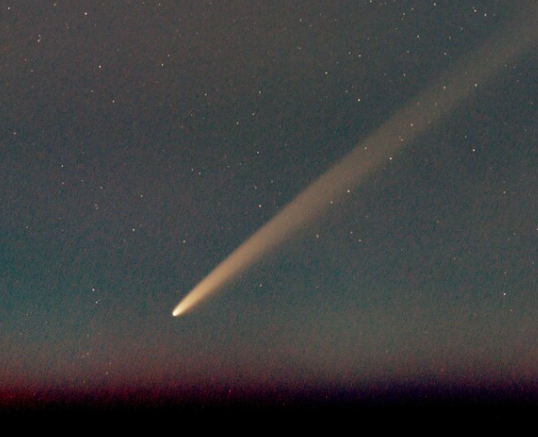
The discovery of interstellar comet 3I/ATLAS by the ATLAS telescope in Chile provides a rare chance to study primordial, extra-solar material predating the solar system, offering insights into galactic evolution and planetary formation.
What You Should Know?
ATLAS (Asteroid Terrestrial-impact Last Alert System) is an asteroid impact early warning system developed by the University of Hawaii and funded by NASA.
It comprises four telescopes: two in Hawaii, and one each in Chile and South Africa.
The system automatically scans the entire night sky several times each night to detect moving near-Earth objects.
ATLAS can detect a ~20-meter asteroid a few days in advance and a 100-meter asteroid weeks before impact, depending on size and distance.
A 100-meter asteroid could cause devastation equivalent to 10 times the energy of the 2021 Tonga volcanic eruption.
In 2025, ATLAS discovered 3I/ATLAS, the third known interstellar object, confirming its role in broader space surveillance.
3I/ATLAS is the third interstellar object discovered after 1I/ʻOumuamua (2017) and 2I/Borisov (2019).
Interstellar objects:
They originate outside the solar system and travel through it in open hyperbolic orbits, unlike solar system objects, which follow closed elliptical orbits.
They are identified by their hyperbolic trajectories, which include a perihelion but no aphelion, allowing them to escape the Sun’s gravity.
These objects provide insights into the formation of planetary systems, as their chemical compositions reveal conditions in other parts of the Milky Way.