NEET 2027 Long-Term Programme: A Guide for Students and Parents

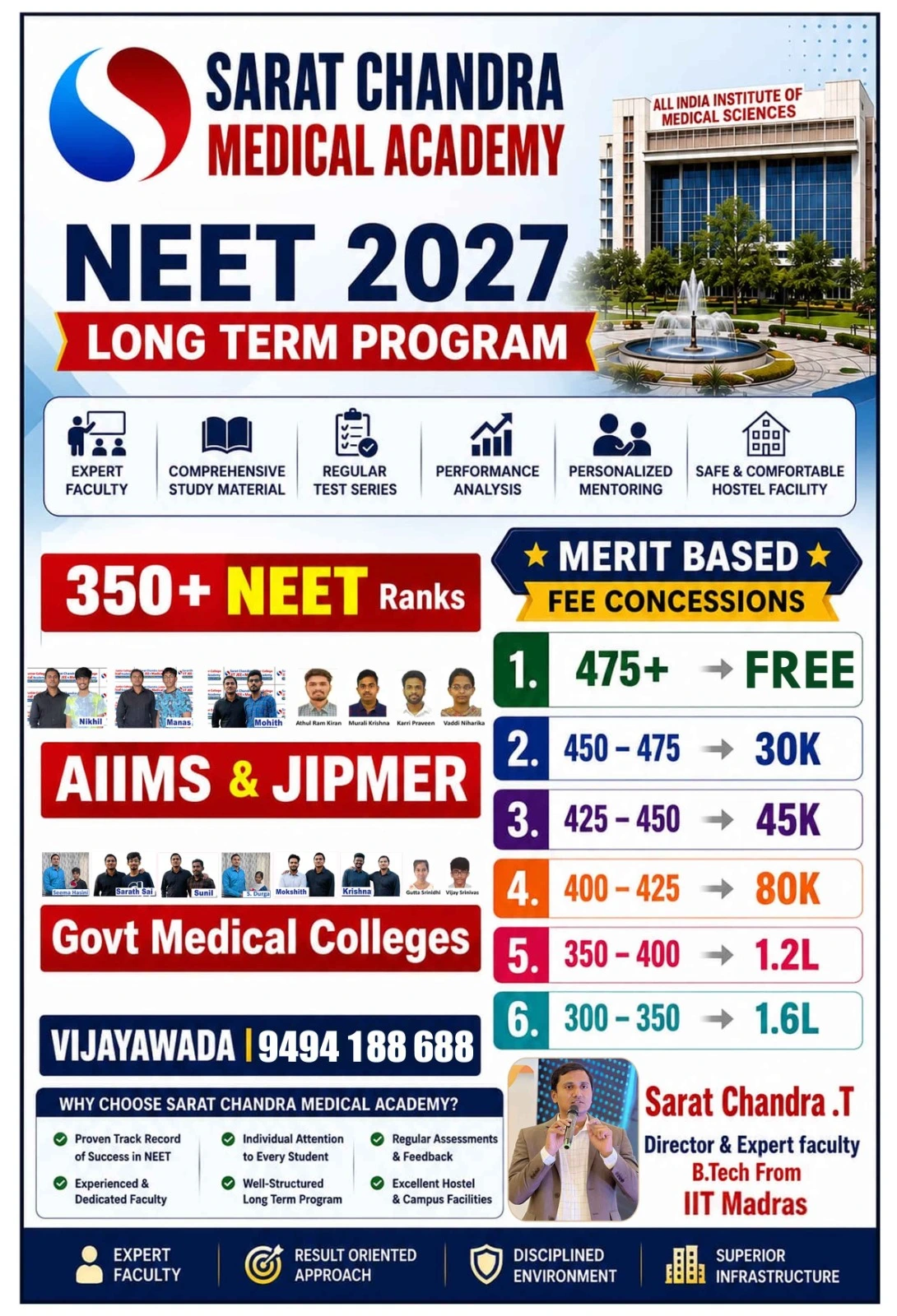
A NEET long-term year gives repeaters and droppers the chance to rebuild preparation with clearer priorities, repeated revision and more deliberate test analysis. It should not become a simple repeat of the previous year. The accompanying Telugu video introduces the NEET 2027 long-term programme and features associated with Sarat Chandra Medical Academy.
Watch the NEET 2027 programme overview

Who should consider a long-term programme?
It may suit students who have completed Intermediate or Class 12, remain committed to medicine, and can identify correctable gaps in concepts, revision, testing or exam execution. Before enrolling, students should review their previous preparation honestly. A long-term year is most useful when the new plan responds to specific weaknesses rather than relying only on more hours.
What a complete programme should contain
A published syllabus and revision plan covering Biology, Physics and Chemistry.
NCERT-centred teaching and recall, especially where exact statements, diagrams and exceptions matter.
Daily practice, chapter tests, cumulative tests and full-length NEET-pattern assessments.
Paper discussion, error classification and a method for repairing weak chapters.
Scheduled doubt support, mentoring and progress communication.
A realistic routine for classes, supervised study, meals, sleep and physical activity.
Think of the year in four phases
Foundation and diagnosis: identify chapter-level gaps and rebuild essential concepts.
Coverage and practice: complete the syllabus with daily questions and scheduled revision.
Integration: use cumulative tests to connect chapters and improve question selection.
Exam readiness: repeat full-length practice, refine time management and stabilise the final revision cycle.
Residential and day-scholar considerations
Residential preparation can reduce travel and place classes, study hours and mentoring inside one routine. It also requires students and parents to evaluate hostel supervision, food, health support, communication and personal adjustment. Day scholars should consider travel time and whether the home schedule can protect supervised practice and sleep.
Questions parents should ask before admission
Who teaches each subject, and how stable is the faculty team?
How are students grouped or supported when their starting scores differ?
How often are full tests conducted, and what happens after the result?
How are doubts, missed classes, illness and academic backlogs handled?
What progress information is shared with parents and how frequently?
Which fee, scholarship, hostel and refund terms are written into the current admission documents?
The student’s responsibility still matters
Even a well-designed programme cannot replace attendance, honest testing and daily revision. Students should be ready to maintain an error notebook, ask doubts early, follow the test calendar and discuss recurring problems with mentors. The long-term year succeeds when institutional structure and student ownership reinforce each other.
Next step: Explore NEET Long-Term Coaching in Vijayawada for programme details, eligibility and counselling information.